
By Irakli Shavgulidze
With the presence of an assemblage of large carnivores and the absence of large wild prey the stage is set for conflict in rural Georgia. Local sheep and cattle farmers, bee keepers and hazel nuts growers live under almost constant fear of their cherished livestock being attacked by wild carnivores. Large carnivores such as bears and wolves, on the other hand, face their own daily dilemma “attack or not attack”. Driven by the scarcity of food in the woods, they often choose to go for livestock, and face the consequences. The consequences are short term and long term. If you are a wolf or bear the short-term consequences may be fatal − behind every sheep you take or bee hives you raid, there is a human, equipped with a gun shot, or a bunch of ferocious guarding dogs, and if you do escape in one piece, you may wonder perhaps you had better stick to whatever food you could find elsewhere. The long-term effect may not be individually as devastating but your innocent fellow wolves and bears as well as eventually the whole of your race may suffer, because thousands of years of co-evolution has taught you that when humans get angry with wild animals they often resort to indiscriminate killing and their anger may spill over to other wildlife too in which case all nature suffers. However, from the local farmer’s perspective it all looks different – we have seen elderly couple at once loosing all of their three caws to depredation in higher Guria and bee hives destroyed beyond revival in Adjara. With the majority of village livestock not insured and no governmental compensations offered for losses caused by wild animals, what hope is left for such rural farmers?
So, how did we end up in this situation in which neither people nor nature can be happy and the coexistence between humans and large carnivores is so difficult? While this question can easily be asked at the global level, here in rural Georgia it’s mainly due to the obvious “fault” in the natural ecosystems − an imbalance between predator and prey. Restoring large herbivore populations is an apparent long-term answer. But local communities need help now because any damage by wild animals can be a big blow to their livelihoods.
For over two decades, NACRES has been studying the conflict between local farmers and wild carnivores especially focussing on the communities in and around protected areas and has found that while the main underlying causes (such as ecological imbalance and habitat penetration as well as poor surveillance) remain the same, the exact nature as well as involved species vary from region to region. Such studies also helped us identify and test various protection methods against wild carnivores. Within our Human Wildlife Conflict (HWC) programme we have tested a number of specific and general techniques and found that electric fences can be one of the most cost-effective methods to keep wild carnivores away from livestock as well as from bee hives and hazel nut plantations.
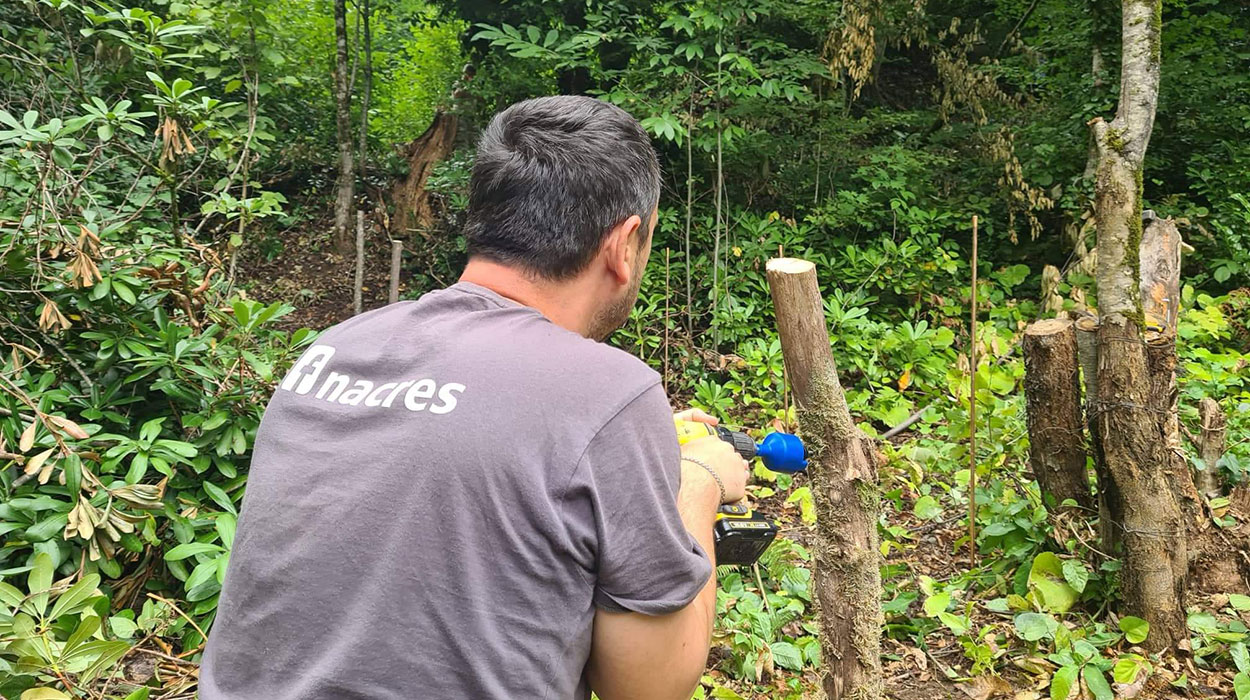
Previously we installed electric fences to protect hazel nut plantations in mountainous Adjara at Machakhela National Park where locals believed that bears from the park regularly raided their crops. The initiative was supported by UNDP as well as by the local authorities that even continued their support as electric fences proved so effective that more and more villagers wanted to have them.